The best dual monitor arms depend on screen size and weight, desk construction, and whether you want side-by-side or stacked positioning. These five mounts cover different needs, so check VESA fit and desk clearance before choosing.
Quick Top Products
HUANUO HNDS7 Dual Monitor Stand
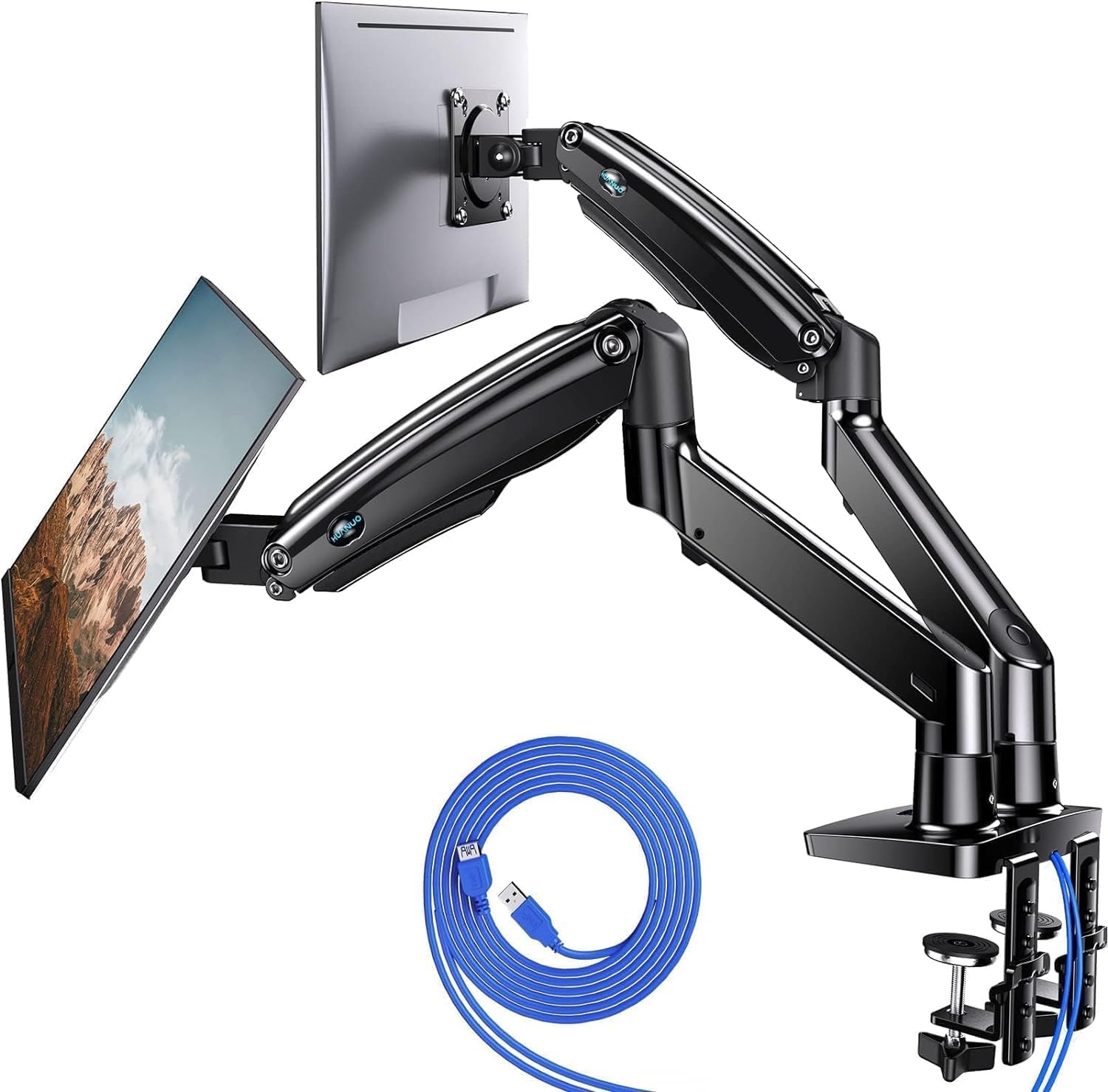
- Supports two 13–40-inch screens weighing up to 26.4 lb per arm.
- Arms rise up to 21.1 inches and extend up to 25.59 inches.
- Includes two built-in USB ports and a 5.25-foot USB cable.
Best For: People mounting two larger or heavier monitors who also want built-in USB ports.

HUANUO FlowLift Dual Monitor Stand
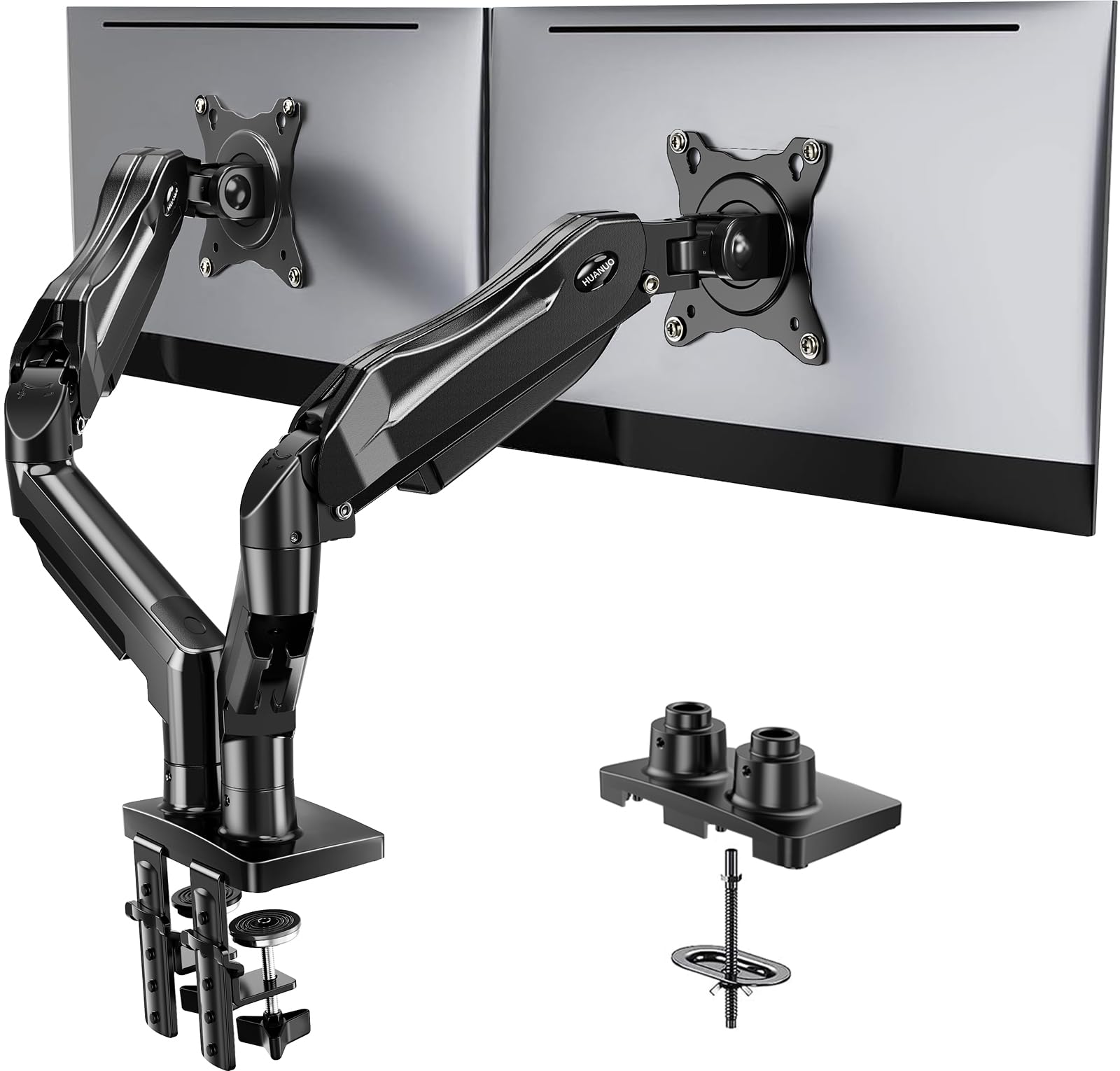
- Fits 13–32-inch screens weighing 4.4–19.8 lb per arm.
- Raises monitors up to 15.75 inches with full-motion adjustment.
- Supports C-clamp or grommet installation.
Best For: People with compatible, lighter monitors who want flexible positioning and cable routing.
HUANUO Stacked Dual Monitor Mount
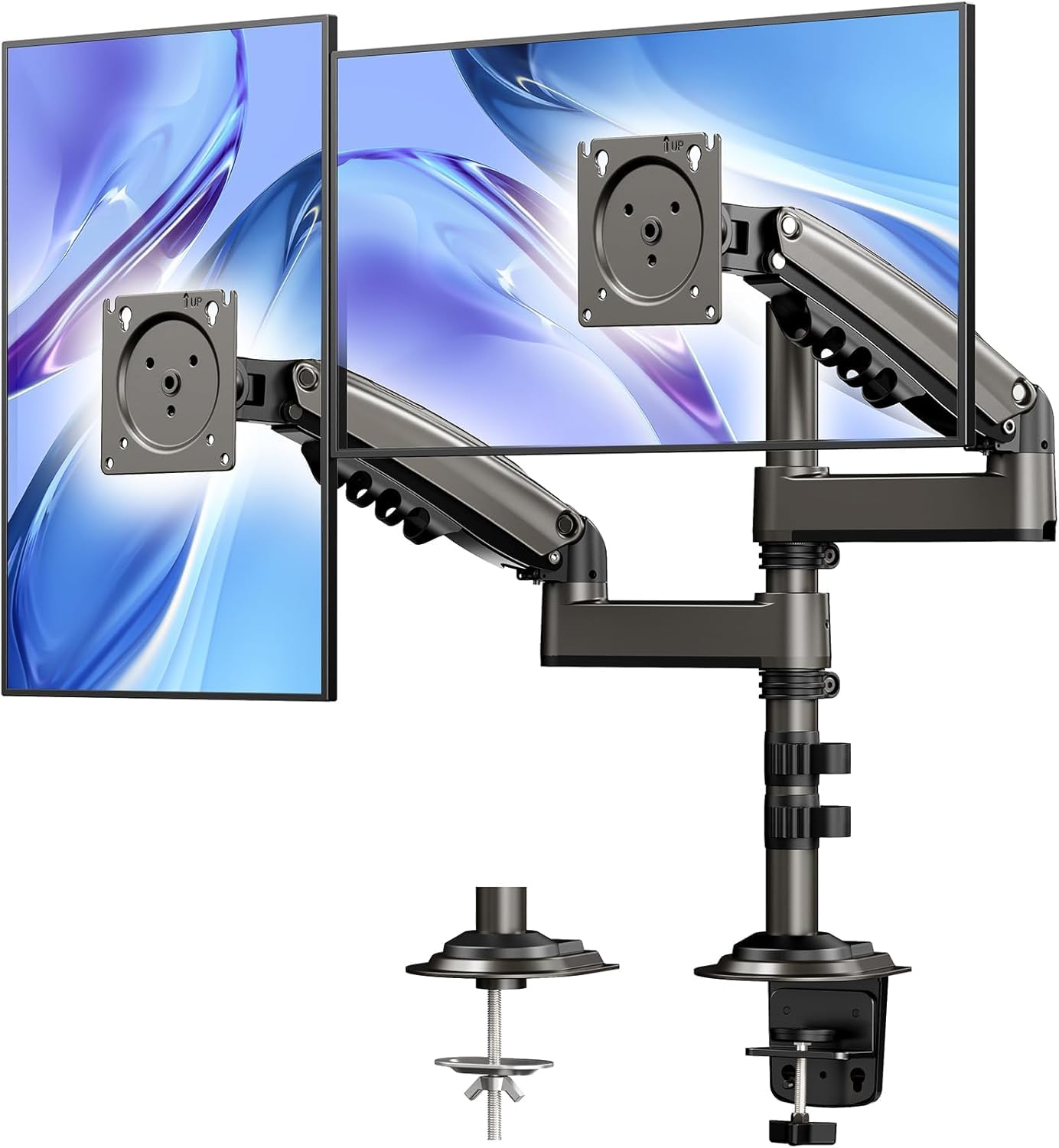
- Uses a stacked arrangement for two monitors.
- Includes a 17-inch extension and raises monitors up to 25.19 inches.
- Supports tilt, swivel, and 360-degree rotation.
Best For: People who want vertically stacked screens and extra height for their desk setup.
HUANUO FlowLift Pro Dual Monitor Mount
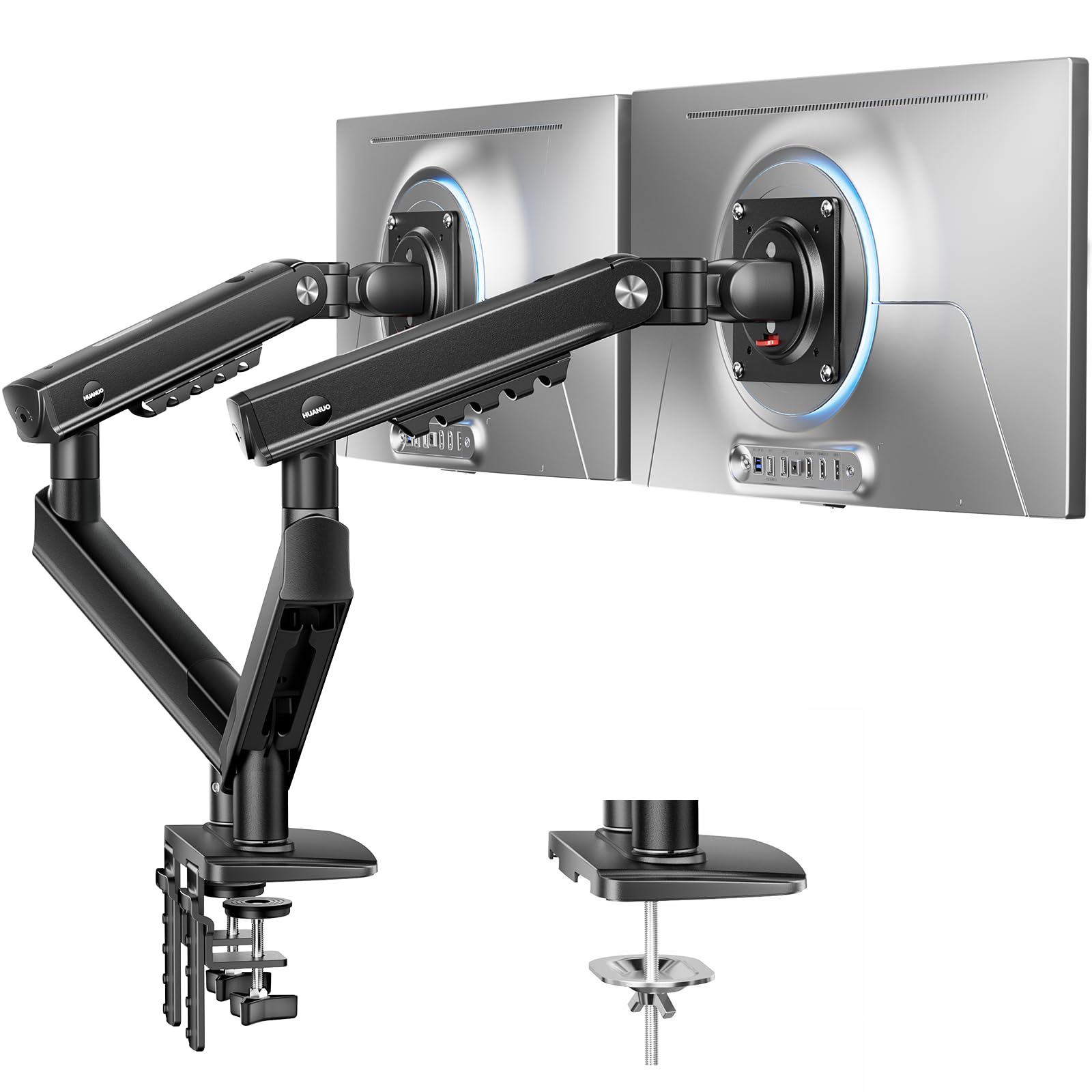
- Fits 13–27-inch screens weighing 4.4–15.4 lb each.
- Uses a tool-free InstaMount VESA plate.
- Provides a PrecisionView window for tension adjustment.
Best For: People with smaller, lighter monitors who want tool-free VESA attachment and visible tension adjustment.
HUANUO TitanLift Heavy Duty Monitor Arm
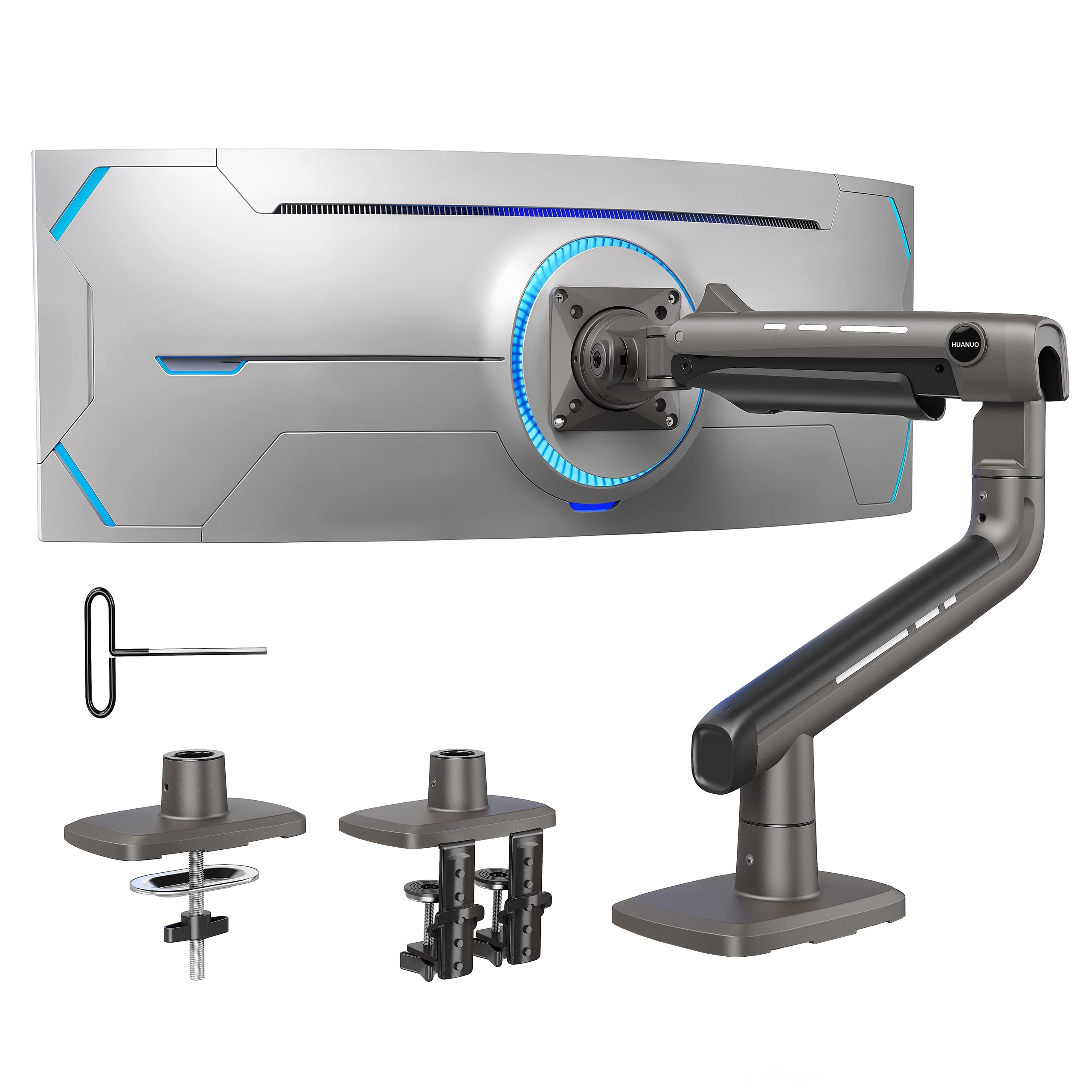
- Supports one 17–49-inch monitor weighing 6.6–44 lb.
- Extends up to 22.5 inches and adjusts in height up to 19.6 inches.
- Includes a quick-install VESA head and cable management.
Best For: A buyer mounting one compatible ultrawide monitor who does not need a dual-screen mount.
For Larger, Heavier Displays
HUANUO Dual Monitor Stand for 13″–40″, Premium Dual Monitor Mount with USB, Height Adjustable Monitor Stand for 2 Monitors, VESA Mount with Clamp/Grommet Base, Holds 26.4lbs per Arm, HNDS7
The HUANUO HNDS7 supports two 13–40-inch screens weighing up to 26.4 lb per arm, making it the broadest capacity option among these dual monitor arms. Its enlarged arms rise up to 21.1 inches and extend up to 25.59 inches for deeper desks.
Full-motion adjustment includes tilt, swivel, and rotation, while clamp or bolt-through grommet mounting accommodates desks up to 3.54 inches thick. Two built-in USB ports and a 5.25-foot USB cable add charging access.
Check your monitors’ VESA pattern and the desk’s mounting surface and thickness before buying.
Best For: People mounting two larger or heavier monitors who also want built-in USB ports.
| Pros | Cons |
|---|---|
|
|
Choose the HNDS7 when screen size or weight rules out lighter-capacity arms, or when the extra reach and USB ports suit your desk. Its 40-inch screen limit and 26.4 lb per-arm capacity are useful for larger displays, but each monitor still needs VESA 75×75mm or 100×100mm holes.
Confirm clamp or grommet clearance and desk thickness before ordering; the two USB ports also require routing the included cable.
For Full-Motion Side-by-Side Positioning
HUANUO FlowLift™ Dual Monitor Stand, Fully Adjustable Gaming Monitor Desk Mount for 13–32″ Computer Screens, Full Motion VESA 75x75/100x100 with C-Clamp & Grommet Base, Each Arm Holds 4.4 to 19.8 lbs
The HUANUO FlowLift uses two arms for side-by-side screens from 13 to 32 inches, with a per-arm weight range of 4.4 to 19.8 lb. Each monitor needs VESA 75×75mm or 100×100mm mounting holes.
The arms offer tilt, swivel, and full rotation, and raise screens up to 15.75 inches. Cable management runs wires along the arms, while the base supports either C-clamp or grommet installation.
Desk fit is a key check: this model is recommended for wooden desks 0.59–3.54 inches thick, with no cross beams or panels underneath.
Best For: People with compatible, lighter monitors who want flexible positioning and cable routing.
| Pros | Cons |
|---|---|
|
|
This FlowLift suits a conventional side-by-side setup where both monitors fit its 13–32-inch and 4.4–19.8 lb ranges. Its rotation and cable routing help when you change screen orientation or want to clear the desktop.
The tradeoff is that each arm supports up to 19.8 lbs, plus specific desk requirements. Check the desk underside as well as its material and thickness, and verify that both screens have the required VESA holes.
For a Tall Stacked Layout
HUANUO 17-32 Inch Dual Monitor Stand, Vertical Dual Monitor Mount, Monitor Stand 2 Monitors, Ergonomic Adjustable Tilt/Swivel/Rotate, Weight Max 19.8 lbs, VESA 75/100mm
This HUANUO mount places two monitors in a stacked arrangement and includes an extra 17-inch extension. Screens can rise up to 25.19 inches, which gives more vertical adjustment than the other standard dual mounts in this group.
Each monitor must be no larger than 32 inches, weigh 4.4–19.8 lb, and have VESA 75×75mm or 100×100mm holes. The stand tilts, swivels, and rotates, and supports C-clamp or grommet installation.
It is intended for solid wood or metal desks, not glass; check the desk thickness and underside clearance before installation.
Best For: People who want vertically stacked screens and extra height for their desk setup.
| Pros | Cons |
|---|---|
|
|
Pick this model when vertical stacking and additional height matter more than positioning the screens side by side. The 25.19-inch maximum height and 17-inch extension distinguish it from the FlowLift, while screen support remains capped at 32 inches and 19.8 lb per arm.
Confirm VESA compatibility and the desk material, thickness, and underside clearance. The stacked arrangement also makes the available vertical space between screens important to check for your workspace.
For Tool-Free VESA Attachment
HUANUO FlowLift Pro Dual Monitor Mount for 13–27" Screens, MechaSpring Monitor Stand, Adjustable Monitor Arms for 2 Monitors with Tilt/Swivel/Rotation, Tool-Free VESA Mount, Max Load 15.4 lbs
The HUANUO FlowLift Pro is designed for two 13–27-inch monitors weighing 4.4–15.4 lb each, with VESA 75×75mm or 100×100mm mounting patterns. Its tool-free InstaMount VESA plate is intended to simplify attaching or detaching screens, and a PrecisionView window provides a visual reference while adjusting tension.
The mount is recommended for wooden desks 0.59–3.54 inches thick. It has a more limited monitor size and weight range than the other dual arms here, so confirm both screens fit before choosing it.
Check the desk edge too, especially if it is irregular.
Best For: People with smaller, lighter monitors who want tool-free VESA attachment and visible tension adjustment.
| Pros | Cons |
|---|---|
|
|
This is a fit for smaller monitors and buyers who value tool-free VESA attachment or a visible tension indicator. Its 15.4 lb per-screen limit and 27-inch maximum are lower than the FlowLift’s, so check the monitor specifications before choosing.
The desk guidance is also specific: wood, 0.59–3.54 inches thick, with caution advised for irregular edges. Those limits make it a focused option for compact displays rather than a flexible choice for larger screens.
For a Single Ultrawide Screen
HUANUO TitanLift Heavy Duty Monitor Arm for Screens up to 49", Holds 44 lbs, Aluminum Ultrawide Screen Monitor Mount, Fully Adjustable Single Gaming Desk Mount with Dual C-Clamp, Max VESA 100x100mm
The HUANUO TitanLift is a heavy-duty single monitor arm, not a dual monitor arm. It supports one 17–49-inch screen weighing 6.6–44 lb with VESA 75×75mm or 100×100mm holes.
Its reach extends up to 22.5 inches, with height adjustment up to 19.6 inches, plus tilt, swivel, and rotation. The rotation specification applies to screens up to 35 inches.
The arm mounts to wooden desks 0.8–3.5 inches thick, and the desk underside must be clear of cross beams or panels. Consider it only if a single ultrawide is what you need.
Best For: A buyer mounting one compatible ultrawide monitor who does not need a dual-screen mount.
| Pros | Cons |
|---|---|
|
|
This arm does not meet the dual-monitor requirement, so it is not a suitable substitute for mounting two displays. It is relevant only to someone whose actual goal is a single ultrawide screen, where its 44 lb capacity and 49-inch size limit may fit.
Because the rotation range is qualified for screens up to 35 inches, check how you plan to orient a larger display. For a two-screen setup, choose one of the four dual mounts instead.
How to Choose Dual Monitor Arms
How We Picked Dual Monitor Arms
These options were chosen for distinct two-screen setups: a larger-screen and heavier-load mount, a conventional side-by-side arm, a tall stacked mount, and a compact option with tool-free VESA attachment. The key selection checks are whether each monitor fits the arm’s size and weight range, whether its VESA holes match, and whether the desk can accept the clamp or grommet base.
Those practical limits determine which products are useful for this keyword.
The TitanLift appears in the candidate group, but its title identifies it as a single monitor arm. It is included as a clearly labeled alternative for someone who needs one ultrawide rather than two screens; it should not be confused with the four dual mounts.
If your goal is specifically two monitors, focus on those four.
Comparing Dual Monitor Arms
The HNDS7 has the broadest stated screen range and per-arm capacity here, plus USB ports and longer arm reach. The standard FlowLift supports screens up to 32 inches and offers C-clamp or grommet mounting, while the FlowLift Pro narrows the fit to smaller, lighter monitors and adds tool-free VESA attachment.
The stacked HUANUO mount stands apart by arranging screens vertically and reaching up to 25.19 inches.
The included comparison table makes the screen ranges, weight limits, mounting types, and distinguishing features easier to scan. Check each product’s own limit against both monitors; a model’s maximum applies per arm only where that capacity is specified.
| Product | Standout features | Best for |
|---|---|---|
| HUANUO HNDS7 Dual Monitor StandCheck Price |
| People mounting two larger or heavier monitors who also want built-in USB ports. |
| HUANUO FlowLift Dual Monitor StandCheck Price |
| People with compatible, lighter monitors who want flexible positioning and cable routing. |
| HUANUO Stacked Dual Monitor MountCheck Price |
| People who want vertically stacked screens and extra height for their desk setup. |
| HUANUO FlowLift Pro Dual Monitor MountCheck Price |
| People with smaller, lighter monitors who want tool-free VESA attachment and visible tension adjustment. |
| HUANUO TitanLift Heavy Duty Monitor ArmCheck Price |
| A buyer mounting one compatible ultrawide monitor who does not need a dual-screen mount. |
Choosing a Dual Monitor Arm for Your Desk
Desk construction can determine compatibility before adjustability matters. The FlowLift and FlowLift Pro recommend wooden desks within a 0.59–3.54-inch thickness range; the stacked model allows solid wood or metal and excludes glass.
The TitanLift also recommends wood and requires 0.8–3.5-inch thickness. Check the clamp area and underside for cross beams, panels, or an irregular edge that could obstruct installation.
A grommet mount needs a suitable hole, and the HNDS7 specifies a diameter range for that opening. If your desk lacks a usable hole, check the clamp dimensions and available edge clearance instead.
Avoid assuming every clamp works with every desktop material.
Which Dual Monitor Setup Fits Your Screens?
For larger or heavier monitors, compare the HNDS7’s 13–40-inch range and 26.4 lb per-arm limit with your display specifications. For a vertical arrangement with more height, the stacked mount reaches 25.19 inches, but its screen capacity tops out at 32 inches and 19.8 lb per arm.
The FlowLift suits mid-sized screens within its own limits, while the FlowLift Pro is the more focused choice for screens up to 27 inches and 15.4 lb each.
VESA fit is another required check. The dual models specify 75×75mm or 100×100mm patterns; a monitor without those holes may need a separately sourced adapter, so verify compatibility before purchase rather than assuming one is included.
Also consider whether you need portrait rotation, a wide reach, cable routing, or USB charging at the desk.
Who Should Buy Which Dual Monitor Arm?
Choose the HNDS7 if you need the largest stated range and per-arm capacity among these dual mounts, or want its built-in USB ports. Pick the stacked HUANUO model if a vertical layout and extra height better suit your workspace.
The FlowLift is a practical match for compatible mid-sized displays and flexible positioning, while the FlowLift Pro fits smaller monitors and buyers who value tool-free VESA attachment.
Choose the TitanLift only if your requirement is one ultrawide monitor rather than two. Its high single-screen capacity does not make it a dual arm.
Before ordering any model, confirm both monitor weights and VESA patterns, then check desk material, thickness, and mounting clearance against that product’s requirements.